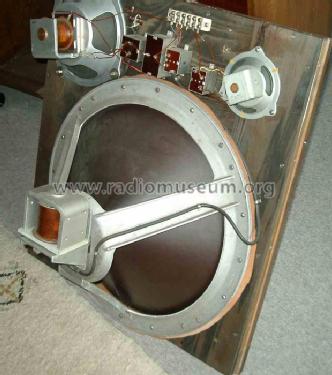
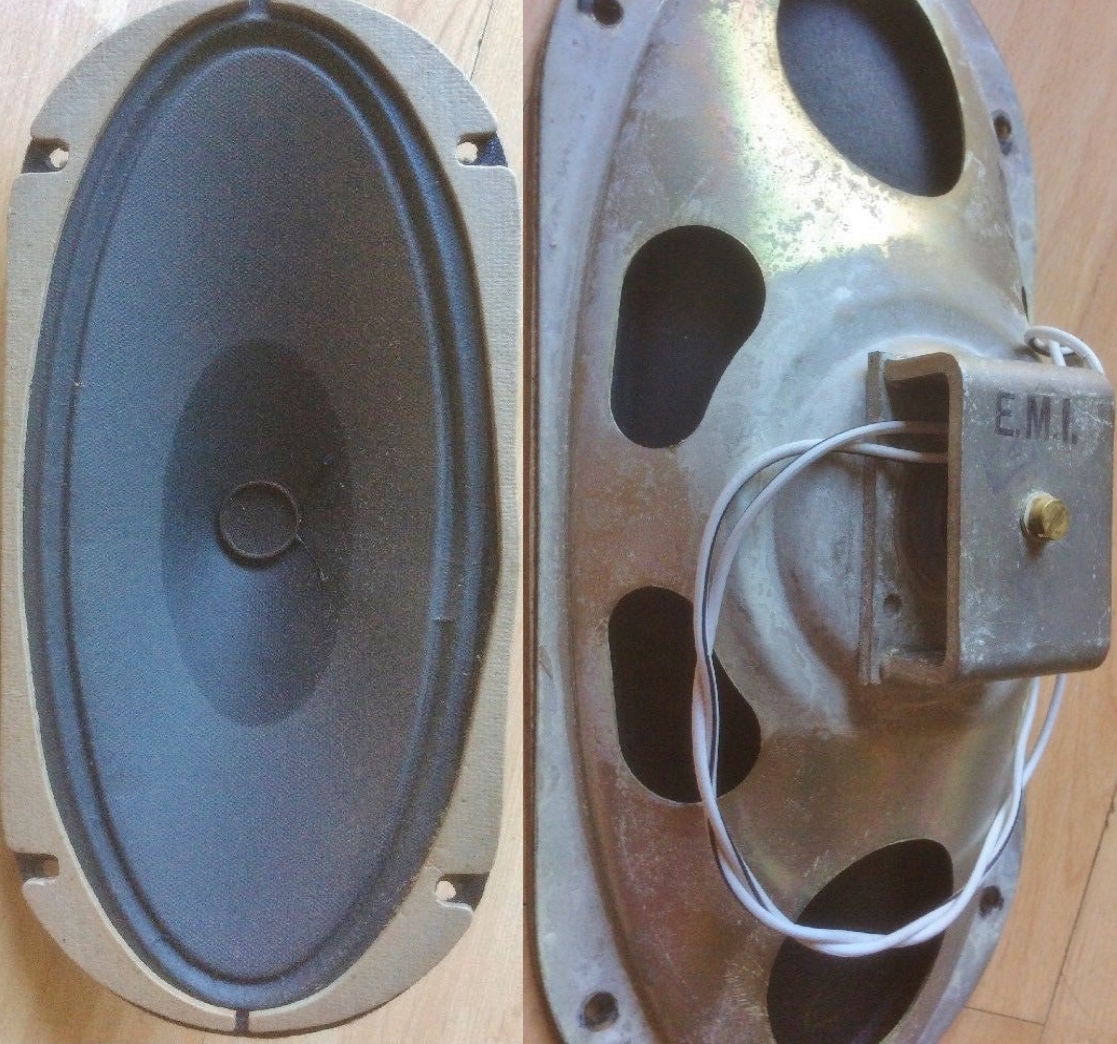
Above, EMI 319, awesome products of their day, build quality suggests impressive results if only the best matching equipment were known and disappointed many using inferior sources and cabinetry. >>92390GK EMI 350, the EMI 13 x 8 and other models weren't available to most buyers but hobbyists of the early 1970s obtained a few surplus examples from electronics magazines and component catalogs.
<<EMI 92390FA, 3-ohm (DANGEROUS SPEAKER 450 series), LEAK STEREO 30. These are a type of speaker known as Lo-Fi using tube amplifiers of low Damping Factor and upper register (20Hz-14KHz). Oaktron of Wisconsin made many Lo-Fi drivers for superb tube amplifiers like the harman/kardon A300, 'Award Series', and today remain largely unknown to enthusiasts.
<<More upper class,
elite society EMI 13 x 8 show tweeters heavily doped and in small
bookshelf boxes, not to drain low power tube or germanium SS amplifiers,
effectively limiting low frequencies reproduced by to above 70Hz. Many
EMI 13 x 8 are capable of low notes at 20Hz but it isn't needed for
Jazz of the 1950s Swing Band style and these use Leak TL12 or TL10
amplifiers, besides the very pricey Stereo 20.
20 watt version>> of the 92390GK are elite speakers from a closed upper class
society sent to high priced auctions from all over the world
but are certainly not to be found on the most obvious online auction
sites. They're prized by the wealthy global vintage tube amplifier owning set and to this day owners claim they beat most other speakers and were true high end, professional studio monitors.
<<20 watt 319, not the lower sensitivity 20 watt 350, either extinct today or in elite places, rare as Helme Audio Bextrene cone 13 x 8 kits most expensive on the mid-70s custom builder's market.
Amplifier>> for 20w EMI 350, pairs of American Bogen MO-100A restored and
found working in Australia, here on Zebra wood veneered plinths. The
size of the Output Iron goes some way to explain why 20 watt 350 weren't
the most popular of EMI 13 x 8 speakers. 4 x Sylvania 8417 tubes are fitted capable of 100 watts. Below, two stud diodes mean Full Wave rectification via center-tapped power iron, the EMI 350 suited to Solid State rectifiers of the stud type, these later EMI Merciless Speakers weren't often heard of.
The
community using Bogen MO-100A with 20 watt EMI 350 were the
professional studio recording fraternity, EMI speakers elite, their use
by hobbyists somewhat novel, getting good sound with EMI 319 more
likely, the 350 has a heavier cone, a third overall weaker in magnetic flux density of the gap,
designed to have deeper extended bass sounds, more powerful, demanding
too much from domestic amplifiers, it's using professional equipment but
on appearances, EMI 350 were attractive to buyers who just didn't
realize they couldn't hope to use them to any successful degree, and
weren't liked compared to 15 watt EMI 319.
<<Launch of American Benjamin EMI speakers in the late 1960s, about which little is known, they were the British Empire elite speakers being hawked in the United States at reduced prices. It was a big market and sped sales. Note the bare, unpainted baffle to prevent reflections, this led to leather and faux leather covered baffles, then sound absorbent black surfaces.
The British 13 x 8 below was carried by the HMV company since the early 1930s, a Lo-Fi Siemens speaker until 1960 unknown to the general public as owned only by the higher social classes. The original paper edge seen was superseded by Waldo Semon's synthetic rubber - 'plasticized PVC' first used in Klangfilm theater speakers. KMAL, Expert, Marsden Hall.
<< EMI 92390PF, professional series 13.5 x 8 inch, the wadding pattern using yellow fiberglass. 15 watt motor. A speaker of the global elites, virtually never seen. Black solid capacitor sits within a wound coil protected in a silk jacket smaller than the 319 x-over. Sound similar to the old DOLBY PRO LOGIC Home Theater where voices are separated out as a phantom entity within 3D music effects.
Above, the very rare 92390PE, only made available to the mass-market since 1964 and as 'P' professional cores. High gloss finish a curious feature of elite only items, estates with a manor house, typical owners of EMI speakers. Left, Adolf Hitler's type 1932 year Siemens 13 x 8 with stray electromagnetic field copper shielding, the original EMI 13 x 8 loudspeaker.
>>Rexine vinyl hide finished EMI 150TC cabinet, the 'TC' being the twin cone version, cabinet also suits the 450 series capable of deep bass using amplifiers of Damping Factor: 5, needs plywood or blockboard. Some are grey/white two tone 1960s styled finish.
Right, extremely rare EMI 150 13 x 8 in a leather baffle FANE studio monitor cabinet used by the BBC of England during the late era of the British Empire. 150 have no whizzer cone of the more commonplace 150TC and are Full Range, Single Point Source. The cabinet resembles the closed elite society's EMI Broadcast 45, a 1964 year elite only BBC studio monitor speaker with awesome burr walnut finish but not shared anywhere on the internet.
The EMI 13 x 8 was very popular with the British aristocracy who'd agreed with some of Hitler's views, although it's seldom discussed why they'd liked Hitler's EMI speaker so much as to keep making it as long as the Empire lasted and even passing it onto FANE in the mid-1960s and Helme Audio in the early 1970s. The Duke of Edinburgh and others had German Nazi era influences and the Siemens 13 x 8 was widely described among the elite as Adolf Hitler's speaker although history on the internet doesn't support this. The EMI 13 x 8 and other Siemens based speakers used war surplus steel basket stampings and remain very mysterious items indeed.
>>EMI 92390DG Green Basket (DANGEROUS SPEAKER 450 series) Zellaton speakers EMI 92390CC. EMI 46600 with thick alloy portion and aluminum wire drive. EMI 92390G based on old 46600 basket. Mullard 5/10.
..
>>EMI 92390FY, Black Basket was a replacement marker, a specially stored new old stock version. (DANGEROUS SPEAKER
450 series), note small magnet in a very efficient 4-layer motor with
copper drive, aluminum in the 1950s AlNiCo versions. Damping Factor 5,
suits Audio Innovations 700.
<<Cabinet of EMI 92390FY and single layer of thin expanded foam, very expensive today as batting. FY resemble the BBC LS3/5A in their high bass cut-off, the FY some 5Hz lower is often seen in a small enclosure, here in v-planked timber with corner dowels. Little is known of these late 1960s High Fidelity loudspeakers exclusive to the British elite. The sound quality is suited to Vivaldi's Four Seasons and amplifiers of 1960s germanium found in the Truvox TSA-100 launched in the year 1964, 4x AD140 output stage, and 12 watts at 8-ohms. The germanium device amplifier is sought after today but very unreliable from chemical deformation of many elements not least the germanium devices themselves.
>>Truvox TSA-100, early British elite Solid State amplifiers, prohibitively pricey and suited to EMI 92390FY above, hearken back to those 1960s times of steam traction on British railroads and memories of Empire when the EMI 92390FY was in-vogue. Note the inlaid wooden pieces beside the front panel and how it looks like new. Truvox made reel-to-reel tape recorders used with the Q.U.A.D. stereo equipment, and these today are still used, some better preserved than others.
>>EMI 92390EH Bronze Basket (DANGEROUS SPEAKER 450 series) suits a Damping Factor 5, 8-ohm amplifier using modern day Audio Innovations S500 (EL34) below, or Audio Note OTO SE (EL84) amplifiers. Although EL34 is more powerful than EL84, the latter is preferred in pricey designs for a first watt sound quality. Audio Note OTO PP has a Damping Factor 10 version of longer throw.
<< EMI 92390EH valued for 8-ohm impedance, 4-layer high efficiency copper drive, thick wire gives faithful reproduction of recorded material. Only work well with Damping Factor 5 amplifiers, using blockboard or hardwood timber cabinets as bass is so powerful.
>>The twin tweeters of the 92390DK appear the same as those in the EH above, but claimed a 17KHz top here covering a rectangular port instead of mounted coaxially. This is important as poor low frequency is often complained of in using these models, meant to use a rectangular port, suitably reduced to small slits, experimenters can try using nine small braced circular holes as in the Altec-Lansing 755, covered at the rear with sound opaque felt with two horizontally cut one-inch long slits made with a modeling knife some four inches apart. Presumably the felt is glued loosely in place. The motor in the DK is a ten watt critically affecting the sound by power rating unlike in modern stereos where a 50 watt Solid State amplifier of Damping Factor, anywhere between 30 an 80 need speakers designed for that modern type of amplifier. In low Damping Factor speakers like the DK the ten watt motor is aimed at a 10 watt amplifier, and better sound will be available from a lower power rating when used with a suitably high quality low power, low Damping Factor amplifier.
Dulci Princess Model LZ220 amplifier (Elizabethan electronics)
1965 year Japanese micro R to R before Philips cassettes.
>>B&W Loudspeakers Ltd from 1966 use an elite only 13 x 8 inch, a 20 watt, 15-ohm 92390FS with 'pepper pot' cone center, under a silk dust cap. Plastic cone twin tweeters are coupled to a mid/woofer something similar to a 319 supported underneath by a ported bass reflex tube. The company began in Worthing, West Sussex and its first commercial loudspeaker was the P1 of 1967, named after a celebrated steam locomotive designed by Sir Nigel Gresley, and as a large engine, a much taller cabinet than seen right. Dennis Ward (a former technical manager at EMI) became a member of the board in 1969, just after Technics launched their often used 40A tube amplifier.
<<The EMI hard P.V.C. cone tweeters of the baffle mounted kind use a yoke alnico magnet, having a lower x-over point than the the 'knob' type seen in the speaker above. Where the mid-woofer cone is light grey it enhances lower frequencies by way of a double cone made of two types of cardboard fused together, the dark grey enhancing higher sounds and the metal center being the mid-range. This was so expensive a technique it hasn't been seen since the 1960s when tube amplifiers with their lower cone control damping factor needed to avoid complex electronic networks such as those in the BBC LS3/5A that is also very low in sensitivity and so not meant for tubes at all, nevertheless many British elite devotees assume the LS3/5A to be the same as the 1960s LS3/5 (presumably using a QUAD II) but KEF speakers were aimed at Solid State.
>>EMI 92390FL, 8-ohms. Note the x-over is of the 'Network-Free' type seen in the Oaktron CA-12 with only an electrolytic capacitor and no inductive coil. X-overs are somewhat complex, radio techs might deduce the exact reasons for their build but don't count on it. The 'capacitor only' gives a very natural sound, later adopted by Radio Shack for hobbyist networks.
<< EMI 14A/1200CA, 'Network-Free' x-over for two foam covered edge, cone tweeters giving wide dispersion with better sensitivity than the new Dome tweeters (usually less than 91dB SPL for 1 watt input). Steel basket hints at large numbers produced, originally for Broadcast studio monitoring in a 'Line Tunnel' British Empire B.B.C. Atkinson cabinet, extremely rare loudspeakers never available to the general public, elite only and in the late 1960s, for very expensive tube equipment made by Leak ; steam Locomotives still widely in daily use on the railroads then.
>>EMI 92390FL, 3-ohms, 'Network Free'. A 3-ohm impedance generally hints at a Class A/B tube amplifier with an Output Transformer. The standard British Hi-Fi impedance was 15-ohms, thought brighter than 8-ohms and technically better but in Japan, 3.2-ohms was the standard with high end JBL horn hybrids made in the 1990s with that very impedance!
EMI 350, Merciless Speaker series with no tarred wiring in the tweeter cone and unlike domed tweeters above appearing in the same day 350 92390BP versions. In the EMI 950 there are aftermarket tweeters with no tarred wiring in the cone and available only to the aristocracy (in the United Kingdom) but mass-market in the US. Just which amplifiers suit 950 is Esoteric Audio Research PL509 by Tim Paravicini each 950 mounted in aristocratic fashion horizontally, one above the other, very strange but they had deep pockets and cost was no barrier, EMI disliked by many as viewed by the lower society as 'posh' or belonging only to the public schoolboy community.
<<EMI 350 are a series coming in many versions, none of which were ever described as to matching purposes other than to the British aristocracy and related education system. Their key feature is the P.V.C. roll edge differing from the more sensitive and much lighter coned 319, that are the 'true' tube amplifier EMI series, the 350 first appeared in 1964 as a professional elite studio monitor, later a FANE copied edition with lower sensitivity aimed at germanium Solid State run at higher volume positions to reach the sweetest part of an output transistor's power envelope, 350 need germanium amplifiers like the Q.U.A.D. 50 or silicon transistor outputs with a simulated germanium sound, the eccentric Q.U.A.D. 303 or LEAK Stereo 30 PLUS.
<<EMI92390FT from the HACKER L.S. 500C. Sellers in the U.K. resisted any attempts to inform them of the product's value.
>>The HACKER L.S.500C uses the 92390FT speaker above and belongs to the EMI 319 series. HACKER were related to Dynatron of the royal house of England, but were upmarket of it and not domestic home market but aimed at schools so not available to the public. Dynatron were pricey, albeit sounding very impressive, deep bass and super reproduction. The 500C will be matched to a wooden music center from the year 1973 aimed at school music rooms and comprising a surplus stock germanium Solid State power amplifier designed to make best possible sound with the 92390FT, but as aimed at a classroom sized listening volume, only suited today for very large listening rooms, despite the small size of the speaker cabinet. The 92390FT above, had been exported to Japan for use in a bigger cabinet aimed at elite houses that have very large listening rooms.
Left a Dyna-Sonic 2T one of the early cobbled-together EMI, surplus core speakers for the general public using 10w ceramic magnet 92390DM and 17KHz twin tweeters over a back wave baffle space. The Dyna-Static was launched in 1960 when in the USA the very first EMI 'DANGEROUS SPEAKER' was offered, the famous DLS 529 based on elite only 1950s speakers. The idea that EMI speakers were hidden from a larger market seems very strange but was due to a social class war.
Haut-parleur, Lautsprecher, Zvučnik,Reproduktor, 扩音器, Højttaleren,luidspreker altoparlante emi.
Right, Sansui made Dynasonic amplifier with 6BX7 double-triode tube and 'Beam-styled' driver 6U8A, sometimes called a triode-pentode stage, toned for the 2T92390DMabove and its tweeters. Below, Pencil M.F.B. of Australia, a Philips design also made in Japan by Sansui.
Right a 20 watt EMI 13 x 8 with two DECCA Kelly horns, is a custom made alternative to the mass market, two tweeters 2T. Like yachts and boatyards, the custom made speaker wasn't available to all. The elliptical cutout and other carpentry skills were only for a few. In this project, a lower board covers a cutout for another 13 x 8 after a fashion followed by the hidden British upper market. Głośnik, Kaiutin, 拡声器, altoparlante, μεγάφωνο, Hangszóró.
Left in the reel to reel player we had an example of the upper market in a global social system. A class war is a difficult idea for many viewers, rarely is a rainbow seen nor the social classes found to be separate. The boatyard made speaker right above belongs to social classes of the reel to reel buying level.
Left 1960 Glyndebourne gramophone available to the purple social class as made by Thorn Electrical, who'd bought over Beam Echo. Speakers resemble EMI Broadcast 45 to this day hidden. EMI 350 high end folded horn cabinet, the model. Prototype. 92390PB has a white LSH85 electrostatic tweeter, 3.5-inch dia, later 3.125 ins, and no grey or white grille.
>> EMI 92390PB, 15 watt, BBC Broadcast Studio Monitor with 319 type 13 x 8. Ted Jordan's Astec single driver was based on a GEC speaker he'd seen and heard, and that had obsessed him for the rest of his life, not clever enough to join the 1950s British imperialist military elite at GEC, the visit was likely to have been something later recreated in a James Bond film.
Left, a 1960s Sugden console, lower-middle-classand the brand Yorkshire based, used with FANE 13 x 8 for Pure 'Class A' and Damping Factor 16 at 10 watts, later with now extinct Helme Audio kits which had a Bextrene 13 x 8 cone few have seen, there being three versions. Below a nearly extinct Benford Horn based on the 'black basket' EMI 350.
Left, the EMI 300T is a posh or 'traditional' version of the contemporary 300C and very similar on the inside with gloss black chains holding the batting in place, and rolled into a large mass. The cabinet is braced and delivers an unmatched 10Hz-20KHz for tube rectifier amplifiers like the Marantz Model 8B, and slightly less powerful 1950s Model 8 for warmer AlNiCo, the 8B for colder ceramic magnet sound. The need to hook speakers to the right tone of amplifier still holds in modern Audio systems.
EMI 300T, a pair at £1800. DLS 529 £580- £2200 a pair.
<<1950s 9206 (British bespoke market equivalent of
DLS529 above not available to the ordinary chap). 92390V Plessey cube magnet 13 x 8 and open back 98890 tweeters have a compressed paper enclosure. Alnico woofers work with harman/kardon A 402 (on account of its being made for the JBL Century L100) so 1960s Marantz Model 8B and not 50s alnico speaker Model 8, 2 or 5.
>>EMI 9206 with grille removed, note baffle thickness for low frequency accuracy. Below a 1970s SONY TA-2650 43 watt per channel system upmarket of the 22 watt per channel ζ40 TA-1630 but with a ζ25 D.F.sobetter suited to Hi-Fi EMI speakers. 1630, 2650 and 3650 weren't V-FET, their Bipolar sound thought just as good by dealer opinion and downmarket of expensive V-FET amplifiers of which there are many, a Solid State simulated 'tube sound', and not unique in that respect, QUAD 303 and others aimed at such but after 1980 year the industry turned away from tubes, and the ζ factor matters if using 1960s vintage Hi-Fi or Lo-Fi speakers.
<<British Empire B.R.C. (British Radio Corporation) Ferguson (Thorn) SYSTEM 25 replies to SONY TA-2650 above, dated spare parts for an awesome simulated tube sound, 1960s Bipolar output devices, surprising internal build, almost Soviet, separate power and controller amplifier once aimed at a wooden radiogram crammed instead into a rack system, 3D sound from Goodmans XB25 speaker parts in a long baffle, astonished owners would never sell.
Above EMI/HMV 556 control amplifiers for an EMI 600>> that with ζ30 dictates the maximum ζ with 1970s receivers for Hi-Fi EMI speakers, the 1984 year, Musical Fidelity A1 with ζ17 is an attractive 1980s option, ζ50 suits faster compliance speaker cones.
EMI mixing studio monitors maybe 3-ohm or 4-ohm and Below 92390FS for the US market Bogen MO 100a with its Beam power tube tone. The large magnet motor needs more power and isn't designed to take 100 watts, the 20 watts RMS rating is a destruction point where pole pieces are be damaged. EMI 92390PA and 92390AE are 3-ohm Lo-Fi professional cores...
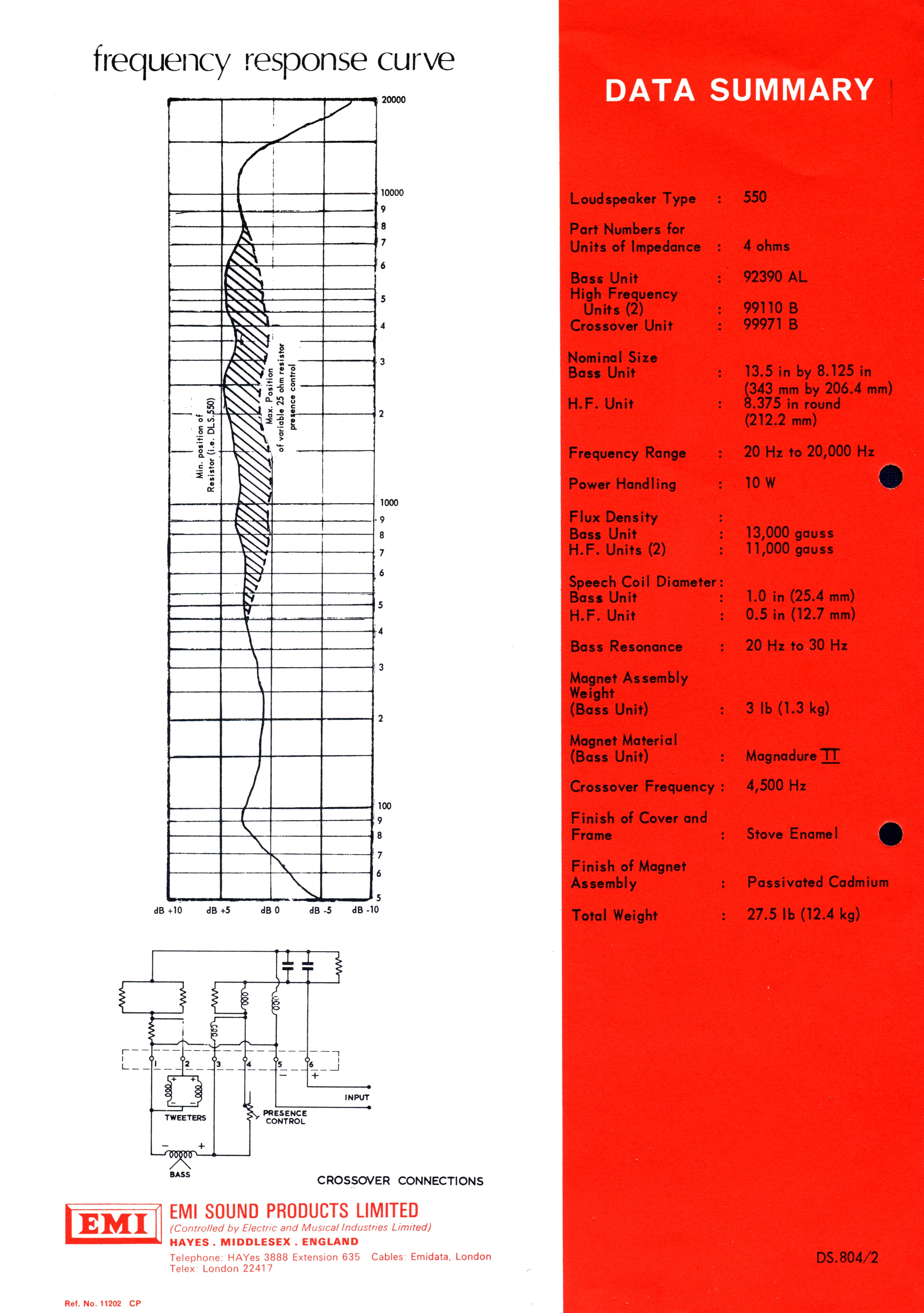
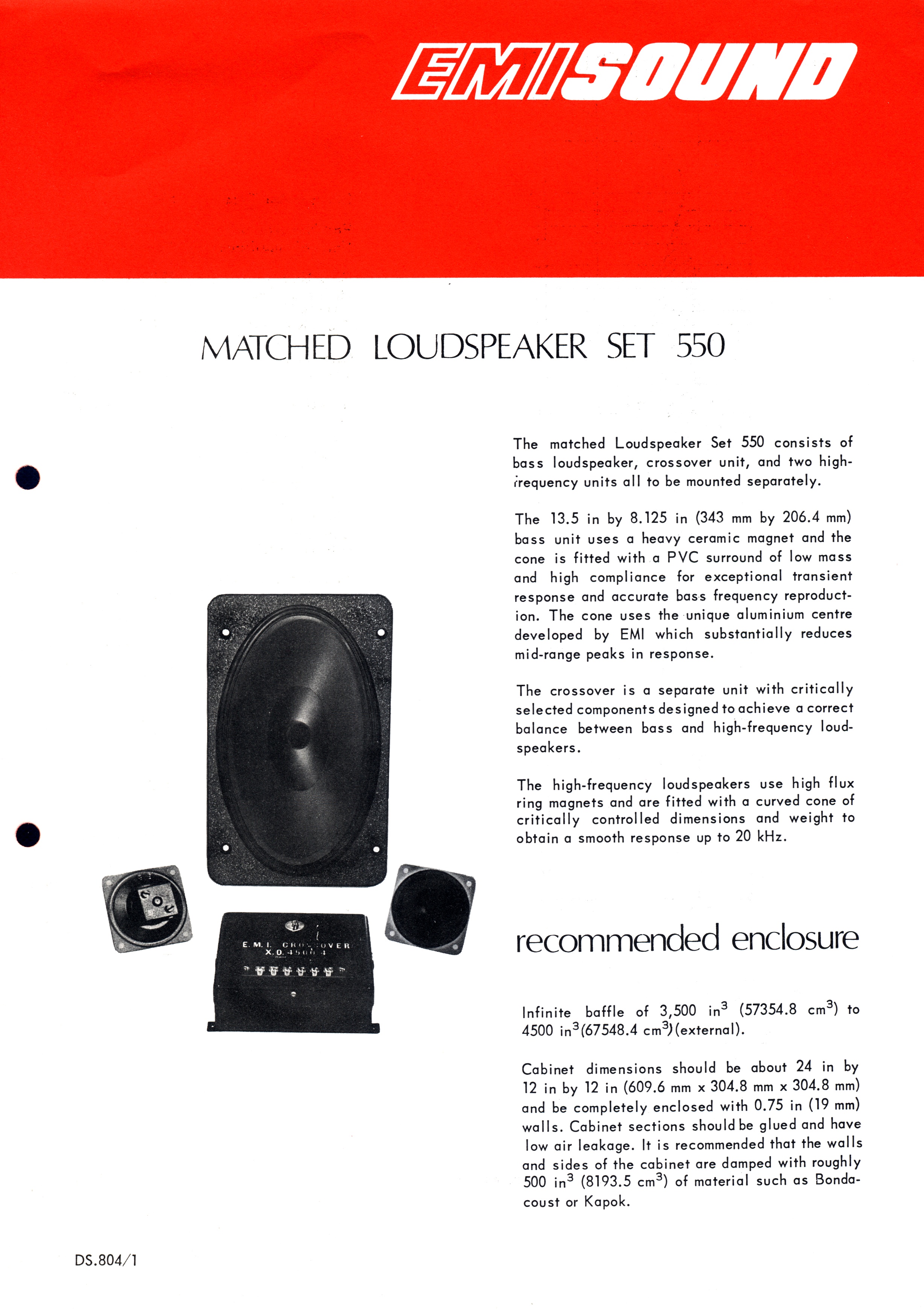
...like the EMI 550, pleated edge, and alloy portion.
Above BBC style self-damping box, boatyard, etc built hardboard on
plywood cabinet. EMI advertised in America as the 'Rolls Royce' of the
audio world, HMV in the 1950s was British elite and nothing is known of such items outside the aristocracy. >>14A/770, 14 x 9 mid-woofer in elite only marketed box with 14A/1720A tweeter. Below, unique photo of American EMI 205 (105) without grilles as briefly featured on Reddit, their 14/770 mid/woofer had elliptical aluminum 'presence' domes in the late-1960s.
<<AERCO Records' studio monitor from 1978 is late to feature a 711 woofer, but like the early issue EMI squawkers might belong London surplus stores, they're teamed up with the plastic-bodied 8 ohm 1970s version of Billy Woodman's late 1960s metal-bodied Axtentsoft dome tweeter using doped cloth suited only for EL34 Output Tubes. <<A Goodmans DT3 Dome Radiator, DT2 in the Magister and G Magnum K2 models, 57107A version in the G Minister of special significance for Westminster politicians, each of different dispersion, priced well above a Hi-Fi tube amplifier's Celestion Ditton 15 long vaunted by the British upper middle class, the baffle is tinted and not painted so as to prevent sonic reflections.
>>Late 1960s EMI 300 studio monitor from a large stately home in France. The 300 woofer needs such large rooms and is a hand made 15 inch claimed to outperform all others and with a 10Hz lowest audible note. The late 1960s 901 and 950 elliptical woofer studio monitor editions are never seen on the internet and use a cluster of six elliptical EMI tweeters with the ten inch EMI elliptical squawker mid-range or double 13 x 8. Foam edge tweeters are seen but the foam simply covers the paper edge that later has P.V.C. added. Note the distance between the mid-range squawkers compared with other designs caters to the 15 inch diameter woofer and note the distance between the tweeters when constructing cabinets.
Left, amazing Omar Skinner brand, Winchester (named after a school) large bookshelf size model with its hardboard, self-damping baffle so clearly fashioned after elite EMI speakers. The difference is middle-range dispersion with just a single squawker and the EMI 14 x 9 offers a full 20Hz low note to the 35Hz of the 14A/1000 mid/woofer left. Button Al-Ni-Co elite Goodmans tweeter and yoke AlNiCo Peerless. Omar Skinner speakers were offered at favorable prices to the British Armed Forces at a time when Hi-Fi was very pricey and little known outside the aristocracy of those years, a Foxhunting, Hare Coursing fraternity, living in stately homes and of course, very different from those still doing so today.
Right, a B&N brand small bookshelf speaker from the late 1960s comprises an EMI 14A/1000 mid/woofer and an Al-Ni-Co tweeter aimed at old fashioned 1950s tube amplifiers but B&N suits the early germanium transistor QUAD 303 up to Serial Nos 11500. The later 303 has a simulated germanium sound but as silicon based may be good enough for vintage Hi-Fi buffs. The Walker QUAD 303 had been the most awesome amplifier ever tested in a New York service center but was degraded in 1977 to favor QUAD 405 sales for the company buyout upon the founder's retirement.
<<Omar Wendover with EMI 14A/1000 custom made by FANE, teamed up with a Peerless MT20 alnico motor cone tweeter for Bang & Olufsen amplifiers. 8 inch mid/woofer has very high sensitivity near 97dB SPL. A port tube is seen and medium density chipboard baffle. Most envied EMI 14A/1000 speaker is the British elite KMAL transmission line using the Atkinson line tunnel know-how of the late 1960s B.B.C. 14A/1000 is low power and won't give best with all low power amplifiers, it suits very expensive 1970s vintage 22 or 30 watt receivers that don't work well with speakers of medium sensitivity but come alive with high sensitivity designs.
>>The EMI 1515 really is a strange amplifier apart from being from the year 1967 and comprising of germanium output devices, it may well suit the 15 watt 14A/1000 above as well as other ge ouptut amplifiers, but it was only ever available directly from the EMI Hayes factory which suggests it had been sold on a 'need to know' basis, in that year the Audio Hi-Fi world was elitist.
Right, the HMV Stereo speakers from the electrostatic tweeter
system below have a curious construction as if containing electronics to drive
the field coil EMI 13 x 8 speakers, possibly early active speakers with an amplifier but from aristocratic living rooms and you know, a mystery to many enthusiasts.
Right, a curved electrostatic tweeter had been available to the British elite and the color seems to match an Acoustical version offered as a horn on a QUAD speaker aimed at the British...
...nobility. HMV had the nobility's patronage and Peter J. Walker had been making inroads before he settled in the lower-middle-class market.
>>1950s British aristocracy had a treble horn colored scarlet like the HMV foil tweeter above. This speaker is an early Q.U.A.D. launched in the year 1949 as the C.R. (corner ribbon), shellac treated wood cheeks are fashioned after an Art Deco style. Fewer than a thousand units were produced as during the mono era. The speaker used a Goodmans Axiom 150 with complex labyrinth/ reflex loaded corner cabinet. The ribbon horn is of aluminum stretched over with acoustically transparent cloth often missing in stereo pairs that don't look identical. Original owners saw these as a breathtaking window into the future of human culture.
Right, a photo suggests that the EMI 901 speaker chassis right below, was mounted vertically in some of the cabinets and the acoustic loading pattern used. Little is known of the 950 and 901, they had cones hand-made in a hat press and a brown paper speech coil former, only for tube amplifiers.
Left, Siemens 'Dimple Top' differ from the older flat tops found in the 1957 DECCA Decola Aristocrat. The later envelope is an East German RFT with a large Getter ring. EMI 901right according to BBC texts were developed to become a new studio monitor in the year 1964 but are never seen in any publications thereafter. A mystery that carried on in various versions and isn't discussed.
Above black chassis STD.373 powers 4-ohm cores with Plessey alnico magnets, in Dutton DLS529 and DLS-1 differing in materials from later Scope 529X and below Benjamin 529A. Gold chassis STD.373>> (and below), gold STD controller has Acoustical Manufacturing Co. cast knobs and front panel resembling QUAD QCII (mono) and 22 (stereo) controllers. Dutton 102 below at twice the price of DLS529 is rare in internet auctions.
When the 711 below right ran out of 10 x 6 squawkers, the Dutton 102 above 20 watts, 150,000...
...Maxwells ceramic magnet core is in some DLS 529X above. EMI 750 a revised 711 has a weaker magnet only 100,000 Maxwells for Solid State power. Left below a European HMV 711 likely from before the American Scope Dangerous Speakers.
Gulf Craft. DSS Ferretti Yachts
Below, RT-VC Viscount III Duo III speaker Class AB output stage with two stud diodes in the rectifier.
<< 28"H. RT-VC Duo III (for the Viscount IV amplifier) resembles the Keletron KS20, each based on EMI 750 below, with two tweeters for both the 20 watt Viscount IV and 30 watt kit version. Tweeters at top are solid capacitor wired in Network-Free from ELAC of England specialist products, outsourced tweeter basket likely of Hong-Kong origin, squawker carried in EMI 13 x 8's concentric mid-wooferalloy portion, a Merciless 750 Speaker, 92390GK8, 15 watt motor, brown paper voice coilformer for fastest transient response. 711 use a separate squawker in a 3-way baffle as a marketing feature, RT-VC, chose a long baffle not weakened by a squawker aperture as made of very thin chipboard, adverts deceptively boast of 'Best Bass'. Keletron receivers and amplifiers were mid-priced around the year 1972 but are today very rare albeit likely to sound good with EMI 750 that's much rarer than most EMI 13 x 8 versions, on account of its lower sensitivity needed for certain Solid State amplifiers.
<<The RT-VC Duo II for the Viscount amplifiers came in different sizes according to year, this late issue bookshelf model cwith 15 watt 13 x 8 KE8 and late issue x-over but no tweeter fitted, 92390KE8 with no fixer holes for the coaxial EMI tweeter mount and uses the 1960s 2.5 inch Audax 8-ohm cone tweeter, FW 5X6A with black plastic basket, based on the E.M.I. 14A series cone tweeter from 1965. 1979 year DUO-II run with the old Viscount IV 20 + 20 watt stereo amplifier, a 30 + 30 watt version for personal shoppers only, uses a Goodmans compact 12 inch speaker with 14000 gauss magnet and matching x-over tweeter set. FW 5X6A is an interesting unit with 18KHz upper limit, Audax an expensive brand and likely to perform well.
>>Audax FW 5X6A, 8-ohm, 2.5 inch cone tweeter, x-over at 2.5KHz, the cone relatively deep. 6dB octave x-over is likely on account of 1960s origin. Use of a single inductor 2-order x-over like Radio Shack R.S. 40-1296A suited to tube amplifiers and RT-VC Viscount IV preserves system sensitivity.
<<Audax FW 5X6A tweeter in the cabinet of the French Audax 13 x 8 mid-woofer, is baffle-mounted and not co-axial. However in the 1979 year RT-VC DUO-II below the Audax cone tweeter has to be mounted coaxially on the two struts across the elliptical aperture, then the surplus EMI 92390K.E.8 mid-woofer placed over it, being sufficiently shallow in depth to allow clearance. The struts look to wide of the mark and some improvisation needed with virtually no 1979 year DUO-II around today, to suggest any buyers ever managed to finish the project.
>>Reddit photo asking online viewers to give the name of the speaker and using the 1960s KEF T-15 and T-27 high frequency treble units. The baffle for the woofer mount is again routed out suggesting the enclosures come from the same French company but as Audax would have their own treble drivers, the maker isn't Audax but a French loudspeaker company that nobody cares to name. The T-27 is only 80dB SPL at 1w/1m and the T-15 between 85 and 88dB, making the commercial production of the combination unlikely unless added to the baffle at a later date, by someone not familiar with loudspeaker design.
>>Audax 13 x 8 with ferrous ring motor are much rarer than the EMI 13 x 8, nowhere online and have no following, but a smaller diameter one is found in a Lecson Audio speaker completely forgotten in the present audio world. France has a number of tube amplifiers made Jadis and tube whizzer coned speakers by Rehdeko but there is really no online support for these. The internet resources for buying vintage French Audio are unknown if they do even exist. The main reason for inclusion of the 1960s Audax 13 x 8 is that its black plastic basket tweeter was sold by RT-VC to accompany their DUO-II EMI 13 x 8, and is not just a cheap aftermarket 2.5 inch cone tweeter. The equivalent of the Viscount IV in France is an amplifier made by Merlaud, the brand still available and dating to 1923 but the history of the Audax 13 x 8 just not available at present.
>>1979 year RT-VC DUO-II enclosure with aperture struts for coaxial mounting of the 2.5 inch FW 5X6A Audax tweeter from the above design, a routed out front of baffle as if to locate the mid-woofer up front. These early Audax tweeters and mid-woofer have been completely erased from the online history of the French company. The small voice coil former is a notable feature of early Audax elliptical drive units and suited to 'Class A' operation using the modern vacuum tube Audio-Note OTO SE amplifier, as well as similar 'Class A' tube amplifiers like the double-ended Q.U.A.D. II, not actually Single-Ended but two tubes wired in parallel to act as if SE.
<<Audax FW 5X6A, 8 ohm, use the K.E.8 FANE x-over on the 13 x 8 woofer, two inductor coil x-overs by Dynatron or HACKER for use with Goodmans 8-ohm cone tweeters of the early 1970s are okay. 6-ohm or 4-8-ohm x-overs shouldn't be hooked to 8-ohm tweeter and woofer systems.
>>1965 year 'EMI Black' tweeter with plastic basket is a very rare elite only model, the later Audax 5X6A above, that was always mass market is every bit as rare, market indications suggest only a handful of both models still exist.
>>92390K.E.8 inductor as fitted to the R.T.-V.C. DUO II, needs an additional 8uF capacitor for the Audax FW 5W6A tweeter. This is the 15 watt version of a thinner 10 watt inductor found on other EMI 13 x 8 speakers. DUO II were supplied as a kit and the Audax cone tweeter and capacitor have been lost as they may have needed soldering at a time when necessary tools and know-how weren't widely obtainable and needed a lot of dedicated efforts that too few buyers could sustain.
<<Black basket 92390K.E.8 differ in magnet detail from the green, both here produced by FANE but the black older and likely higher in efficiency as suited to tubes rather than Solid State. A pair of black basket 92390K.E.8 are found in the older, taller DUO-II edition.
Right plywood baffle of an EMI 711 showing the higher power tweeters. Left comical GLL Oxford, probably the last speaker's failure to bring the lower man to an inclusive musical experience. Thereafter the higher society largely lost interest and quite rightly so.
Left, acoustic batting for the 711 with plywood panels. Elite lifestyle was boring for the lower man and vice versa, GLL didn't get that and followed the austere Oxford with increasingly exquisite finishes until they went belly up. NSU Ro.80 was another disaster, Rolls Royce driving for the lower driver. EMI Dangerous and Merciless speakers of the 1960s, each hoped to get the lower man up to par. The EMI DLS-1 are narrow tower speakers like the GLL IC 120 Oxford left but date from some forty years before and use less power for similar sound pressure levels. Arthur E. Falkus was a Fane founding partner, Fane 13 x 8 and tweeter AF speakers right lost in the mists of time. Keletron KN800 and KN1100 have a Falkus 13 x 8. Left 'Monolithic' QUAD II. Stereo has two small QUAD II mains transformer versions power AM, FM tuners and 22 controllers set but are often overloaded.
Right, the EMI RS.141 was a Studio Monitor tube amplifier produced jointly by EMI and H.J. Leak and a tricked outLeak TL 25, working with the famous Abbey Road Studio Monitor speaker known as a 'White Elephant', used to record 'The Beatles' Rock band, using British GECpresence tweeters with an American Altec-Lansing Bi-Flex speaker from...
... the year 1947. Left, a rare look inside reveals a vertically mounted tube chassis to improve Output Tube cooling and the Output Transformer used, a large multi-can electrolytic smoothing can, is silver soldered to a number of stud diodes, 25x more expensive than basic rectifiers and vastly improving sound quality, as in the 1972 RT-VC Viscount Mk.III amplifier for surplus EMI 13 x 8 available to electronics engineers.
Above and left, the Concord CR550 produced by Benjamin Electronic after making EMI cored loudspeakers, appears similar to Radio Shack's REALISTIC, the power output stage as well as the radio stages using Simple Circuitry for simulated tube sound, a single heat-sink reduces box footprint size.
In the 1970s EMI had Lockwood Audio sell several flat-pack cabinet kits, the L.E.4 right one of the ready-made examples. The sad thing about anything made for the lower man is the effect of price on some aspect of performance. Vintage audio mixed with modern equipment stems from an assumption that it's all alike and all sounds good to somebody.
QUAD II is very popular today, particularly in Solid State rectifier versions. The 1982 year Concordant was by Doug Dunlop. The 1960s, elite only one left had been owned by horse racing people, its details published in the 1970 Hi-Fi News and Record Review magazine for fellow listeners of the EMI Merciless Speakers. The AcroSound made REALISTIC 210 below had a Solid State rectifier in 1962 and retains separate ECC82, unlike the Scottish Concordant modification that controversially used space compromised vacuum tube, ECC 83 to increase power to...
...22 watts, bettering the RCA Orthophonic. Increased power allows speakers to be further apart. QUAD II isn't much liked by the elite, using the LEAK TL12 instead but the 1950s QUAD II has a very low, 0.02% THD and was used first with Stentorian speakers when Harvard University Law graduate, 'Bud' Fried planned his I.M.F. Hi-Fi Company to import the first American, QUAD ESL57 electrostatic speakers in the 1960s. Right the stereo pair QUAD II differs from the mono sets as nearer tolerance of stereo speaker pairs sold at the time. QUAD electrostatic ESL57 gave within 40Hz-18KHz when sold in specially matched stereo amplifier/ speaker pairs, mono QUAD II reckoned too difficult to make a stereo pair from.
Above, the rebuilt 22-watt Concordant QUAD II and left Goodmans Axiette it used as a ceramic magnet single-point source, the two brands often seen together in larger middle-class city houses. Affluent late 1960s Goodmans Mezzo speakers snapped on a unit where sound is reflected up from the flat surface beneath destroying sound quality, vibrations from the speakers reach the record player causing a howl but these very different days from the present when few people had stereo, never mind 'separates' like these, largely a time of Music Centres or mono radiogram equipment until the mid-1970s.
Left, use of Goodmans Mezzo with SONY TA-5650 V-FET, the Mezzo ferrous Low Frequency woofer motor is similar to SONY Carbocon SS-5050 woofers but the Mezzo x-over has none of the 5050's small iron core inductors. SONY SS-5050 sound balance has been likened to Billy Woodman's ATC speakers of Goodmans heritage.
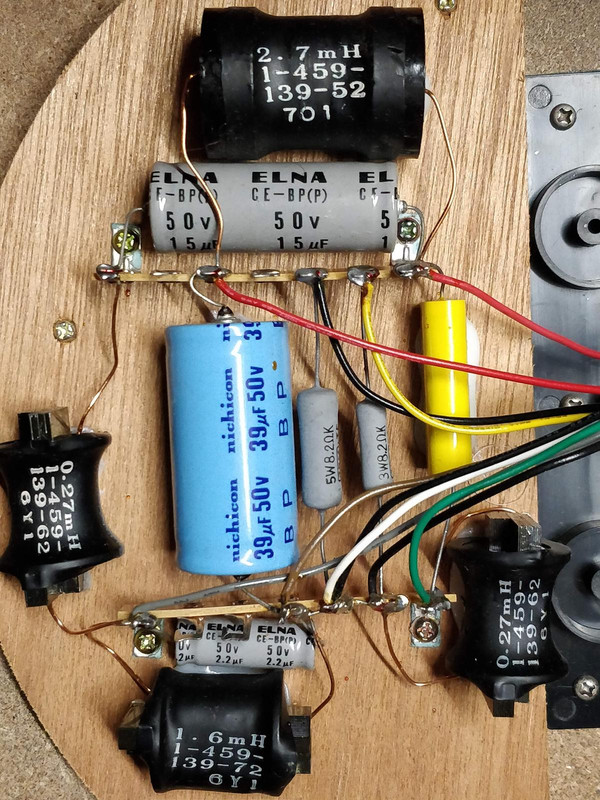
Right, the Mezzo x-over on wood resembles the plywood x-over Carbocon 5050 that instead has three electrolytic and one solid capacitor making the revered tonal balance of a TA-5650. Carbocon SS-5050 isn't tonally similar to the later SONY SS-G7 or just any other speaker. SONY V-FET is praised by Nelson Pass but were poorly made mass-market rack systems meant as a one-brand stereo system and not as tolerant of other equipment as separates. AcroSound
Left what may have been a 'matched pair' of 92390EA cores, left and right stereo channels ideally have identical electronics, function, and form but even modern mass-market speakers and amplifiers vary in abilities. By playing one and then the other speaker on each stereo channel, often one appears better.
>>Box of the EMI LE.1 above, is a T-slot with the batting pattern shown. The driver is an 8 inch by 5, very seldom seen. Down page, a 10 x 6 inch speaker sold by Thomas Henitz in his Moscow Road London store where he'd advised customers to 'listen to the music not the money'. Ferrous motor is small as aimed at tubes or germanium output devices. The EMI T-slot differs from the rectangular port in the Henitz but would find similar London customers. Low bass of such speakers had to be lifted by resorting to such methods and are still useful to owners of vintage amplifier and audio input sources but of virtually no use to modern equipment where more power allows dynamic long excursion small diameter drivers.
<<Most famous T-slot is the Radio Shack Optimus T-70 by Realistic of Fort Worth, Texas. The EMI LE.1 was so rare and exclusive, found only among elite buyers, it's possible that RS sought to take the design to the extreme for the mass-market but the sound makes it one of the most impressive small floor-standing speakers of all time. The T-70 is a foam surround and many were lost before replacement foam surrounds became available. The remaining cabinets often appear scratched and damaged with other replacement woofers and tweeters fitted but are worth looking out for as projects.
<<EMI LE.1 cone detail. Whilst the quality of the speaker may be evident, sound available to original elite buyers has to be compared with Jean Hiraga's 'Le Petit' cabinet design, his full range driver boxes compete with high end and get so much from a small 4 inch single cone speaker, they'd beat a ten inch lower market design and just about any medium bookshelf enclosure, albeit using high end input equipment. This LE.1 example appears to have been doped with varnish and is expected to vastly outperform the 'Le Petit' drivers, some very pricey today, LE.1 don't exactly grow on trees but are affordable if available. Nelson Pass made a similar kit box project using a Lowther full range drive unit, the S.L.O.B. Click on images for full scale views. Below, Linear of Leeds, 5 watt germanium stereo amplifier.
<<10 x 6 inch ELAC of England or Goodmans of Wembley elliptical speakers had such grey stamped steel baskets, off the shelf or custom made for many speaker enclosures, their most remarkable feature being extremely efficient, room filling sound. Frequency Response varies but the small magnet seen is likely most active above 100Hz, not that its high efficiency would be traded for a better bass, buyers with suitable vintage systems would absolutely prefer these Henitz boxes to anything more modern but only sound good with vintage, low power output amplifiers like the Linear STEREO 505 with its ancient split pin speaker sockets uses a Garrard 2025tc turntable with KS40 (41) stereo cartridge.
Left last Lo-Fi 13 x 8 sold in London, pricey elite buyers, below a Bentley 3.5 litre. Dragon Assoc.
>>Constructors note the cabinet size of this idealized EMI 14A/770 design is 90cm high x 48cm wide but the depth wasn't given and by the look of the long tarred wire voice coils, may be a 105, below, silver basket 1965 year issued, doped cloth edge version of later p.v.c. roll edge, green baskets seen in the EMI 205 (14A/770NC) and 215 (14A/770NX) editions ; where the mid range speaker suspension is seen as deformed, it usually causes distortion as a loss of clarity. The backdrop likely comes from an abandoned home where the speakers were being turfed out before either demolition or renovation, the wood paneling and skirting board show some weathering.
>>14A/770C excluded from the Merciless speaker advert, part of the mid-1960s 14A series, the 950 being the 14A/600. To say nothing is known of these would be untrue, they're 105, 205, and 215, early versions have a choke on the chassis leg and they were used with Radford STA-25 valve...
...amplifiers below, an affordable upper-middle-class favorite. <<<FANE copied EMI 14A/770NX shows the impossible effort needed with a vintage router. Brown impression on the NX style motor casing was made by a wooden post fixed to the cabinet rear, and not square but with only one square edge and others angled, perhaps a section of hardwood banister recovered from an old house, possibly from a stately home, times when many ruins were being demolished and antique souvenirs of a bygone age, sold off like elite EMI speakers after the year 1972, in the end of Empire days that brought a decimal currency to the U.K. Many buyers from the U.S.A. came buying former country manor house antiques at that time., many railroads taken away then and their track beds highly visible.
EMI 215 right had appeared in 1967 and was the 14 x 9 version of the fiberglass mix cone 13 x 8 of B&W, Bowers & Wilkins of England, the 92390DJ of the DM.3. The 215 enclosure boasted of its ability to reproduce bass to 20Hz. Today not many speakers offer below
35Hz but in those far off days before sub-woofers, followers of Hi-Fi could pay high prices for amplifiers able to give 20Hz at low power and minimal distortion. Mostly lower frequencies are poor quality in affordable amplifiers and this made the 80Hz of the BBC LS3/5A attractive to buyers of the lower society. Another problem of superb speakers for low frequencies is the room acoustics and inputs to make the most of speakers like the EMI.
Left, the EMI Model 205 is rarer than the 215 above and has 25Hz as the lowest note. As EMI comment in the advert, the achievement of such a deep sound in a compact cabinet at low distortion levels is unequaled by any other brand of large bookshelf speaker. They are high sensitivity and make the most of low power tube amplifiers like the Leak TL12. However finding an EMI 205 will be quite a feat and most enthusiasts build their own from components. Below, the Lo-Fi 10 x 6 is much rarer than Lo-Fi 13 x 8. They're for Lo-Fi Single-Ended amplifiers, the upper HF limit of 13KHz more than any would need. Hi-Fi versions are the 630 (black cap in choke) ...
... for a tube rectifier, later 650 for a Solid State rectifier, (red cap in choke). Lo-Fi means up to 13KHz for high-quality amplifiers of the 1940s. Left with a deep bass not mounted in gramophones, build quality tells much about capabilities, partnered with Single-Ended KT66 amplifiers below, that fetch £1000+ today at auctions as built to last a lifetime, elite vintage gets regularly refurbished. The Lo-Fi is a low Damping Factor amplifier needing the stiff pleated speaker surround. Whether 'Class A' or 'Class B', needs some trial and error. Right BBC style self-damping speaker enclosure by 'Heathkit of England', part of the U.S. company - uses EMI 550below and two cube form alnico 3.5-inch tweeters (like the DLS529) but with Single-Ended amplifiers like the 'Class A' Dynatron above, supplied to Buckingham Palace. Below an actual 550 as 92390CR, one of the rarest EMI 13 x 8 and only found in 4 or 5-ohm impedance. 574G valve. Right bass-reflex slit.
Left and above, HARVERSONIC SUPER SOUND 10 + 10 Amplifier Kit with 5-ohm EMI 92390CR capability, mouse click images.
2N3614 PNP TO3 Germanium output 60V 15A 77W in the SUPERSOUND. Left, 92390CR, 5-ohm 550 13 x 8 and with no alloy center in a Lo-Fi version below still with 15-watt magnet, 10-watt coil and doped acoustic center for less pricey amplifiers and equipment. No choosing of straws for buyers of surplus 13 x 8 and vintage bargains.
Early EMI drivers from before the 1967 Merciless Speakers offer hope of something special but speakers like the cobbled-together Mordaunt Short MS-400 below are for lesser equipment. Just don't judge EMI from a mass-market perspective, they were for British elite buyers with deep pockets.
Right not on YouTube to date, five or more Mordaunt Short MS-400 appear, this the first issue 'brown baffle' with early 13 x 8 bass. Note the wonderful, Lockwood Audio black tinted baffle, washed from around the driver apertures to limit reflections. A cobbled-together resin board x-over isn't for elite EMI sound, only profit-led thinking, quickly getting rid of unsold drivers. IMF dropped the KEF T-15 aluminum dome tweeter seen in the rare split baffle STUDIO as the BBC found it colored and the later Rogers LS3/5A, with its KEF drive units isn't a genuine BBC monitor either but a purple social classmass market speaker, good as working well with affordable amplifiers. The next MS-400 is the 'black baffle' left with a round 12 inch EMI bass unit. An enthusiast could rebuild the x-overs to a BBC reference using the Klipsch x-overas a model. People who restore, must not paint the baffle, just leave the finish. Very difficult to improve such a surface, intended to absorb sound reflections. Painting may well look and sell better but intended sound needs it left original. As to what amplifier best suits the KEF T-15, any purple mass-market Solid State amplifier that suits a Rogers LS3/5A is easy to find.
>>A gardener's speakers from an estate sale, KEF T-27 tweeter suggests the CELEF brand trading in the U.K. only during years 1973-5 (later PRO-AC), squawker appears to be a KEF. EMI 14 x 9, 14A/770NX woofer. Use the early 1970s silicon QUAD 303 or late 1970s 405 power amplifiers.
Right the record player part of the Concert Grand French Provincial console, American mass-market reply to the British elite's DECCA Decola Aristocrat. A 'Phantom' control electronically mimics the EMI speakers in the upmarket DECCA. The search tune sensitivity hails from days before PLL tuning but really caters to 'knob twiddlers'. Below Export American market EMI 556 Stereoscope Control Center, for 557 and 600 power amplifiers. Too many knobs and an oscilloscope, home constructors using instead magic-eye tubes. EMI speakers of today weren't available to the mass-market but only upper-class bespoke dealers.
<<EMI 519 speaker, (US$3391 a pair in today's money) 13 x 8 inch 92390G with Plessey cube alnico and twin cube alnico cone tweeters, found in England but rarer than Hen's teeth, matches the 582 wax-figured walnut console shown with HMV 555 stereoscope integrated tube amplifier below, using EL84 Output Tubes and the seven tube EMI 558 AM/FM radio tuner with selenium contact-cooled rectifier, one of the lowest in audible loudspeaker noise but not recommended for use today, it has to be replaced by a service tech, a straightforward job using an old 1N4007 rectifier diode and chassis cooled wire-wound resistor. Click on image for full view.
>>Celestion ring-radiator tweeters from the later 1964 year EMI 519 loudspeaker with 13 x 8 inch 92390G speaker found in the US DLS529 with similar but different acoustic loading quilting. These use an EL34 output stage different from the earlier edition with EMI cone tweeters. The x-over isn't enclosed within the black plastic box of the US export DLS529, a box that apparently prevented pressure changes from blurring the musical details, the lack of the plastic box is very strange, it might suggest export versions were higher spec but the 529 series had Plessey cube magnet cone tweeters that hadn't been of Limited Production.
<<X-over of the US DLS529 has additional capacitance and resistance, the metal base x-over usually concealed in a pressure safe plastic box. More elements in an early vintage speaker x-over are often a bad thing with such tube amplifiers and seen in KEF speakers, mean using Solid State amplifiers of an expensive kind is the intended choice. Note that more elements in a tube amplifier's speaker x-over needs a tube amplifier with a higher Damping Factor than those often of 'Class A' construction but that the modern tube amplifiers of the US Manley Snapper specifications, aren't suited to vintage x-overs and loudspeakers, these are very powerful modern amplifiers for modern Tannoy speakers from China.
>>X-over in the UK DLS519 with double Rola Celestion ring radiator tweeters, has less capacitance and resistance and lacks the later added solid capacitor seen in black above, that adds considerable definition of musical images. Quilting differs from the US and sound is likely different. The absence of certain elements in earlier x-over designs likely had a sensible reason, that enthusiasts need to consider in using these vintage speakers with tube amplifiers of various specifications. Bad or disappointing results often come from not running the equipment together as a set for a sufficiently long time.
Below and right the HMV Stereoscope controller has additional tubes in the compartment that the integrated amplifier down page has occupied by its power amplifier stage, and this allows the power iron to be enclosed in the grey steel box seen, thereby reducing the hum noise component at the preamplifier stage. The 557 10 + 10, and 600, 30 + 30 watt power amplifiers are seldom seen but were known to the 1960s British elite. Turntable is a Collaro transcription with EMI arm and Headshell.
>>In the mid-1960s Hi-Fi tuners like the H.M.V below were mono and had a white core R.C.A. Multiplex output socket that connected to the multiplex unit, the Q.U.A.D. right, an FM2 unit often bolted to the FM2 rear panel. The FM3 is not as great, the Stereo FM2 just awesome using the germanium QUAD 33/303 but only suited for strong city reception. Whilst the royal H.M.V. tuner below, would have its own multiplex unit, they're as rare as hen's teeth.
<<The Multiplex output is a single RCA socket that connects to just any multiplex unit.
British export EMI Stereoscope 555 right says 'Made in England' but from a Hungarian design of the 1959 year, perhaps obscure Habsburg and Ottoman royal lineage in UK influences valued by an elite. The video set right offers +/-0.5dB, 30Hz-15KHz, 20 + 20 watts American (nearer 10 watts British power). Below chrome trim and black trim above are seen with many EMI and HMV detail differences.
Of this color the ace of clubs announces great spiritual satisfaction and a period of prosperity, a very good omen in every sphere of life bringing down negative power of the spades. Hidden meanings were a particularly British elite thing not liked by others. EMI 'Club' 16 x 11 loudspeakers were probably named after the playing card, a cryptic Kubrick film below attempts to explain elite secrecy. EMI equipment itself secret only emerged in the days of internet auction sites.
Left an elite magnetic badge from the steel basket weave 'Dangerous Speakers' of the early 1960s, often missing in auctions. Some of the steel grilles are copper color or gold. The red felt edge and grille cloth show remarkable workmanship for superior buyers.
EMI 92390 13 x 8 suit low powers and differing Damping Factor amplifiers. The 319 sounds good with 1970s vintage but the 450 needs 1960s. 1990s amplifiers of Damping Factor 60 are for polypropylene cones and won't give the best results with 319 or 350.
Left, a ported-reflex Carad speaker from Belgium with DECCA Kelly Ribbon Horn, very early 1960s with Lockwood style cabinet. Flared aperture cutout is copied to Revox and the 1978 Technics SB-X5. Carad were elite Audio amplifiers, first tubes later Solid State, little known by the mass-market. Belgium was imperialist, occupied by Germany in 1940 and had strong interest in EMI speakers after WWII, Siemens, made the early EMI 13 x 8, the factory had a long influence in the country. Adolf Hitler was widely believed to own a Siemens 13 x 8 that's hard to support today with internet pictures but they remain the most mysterious looking in the Hi-Fi world, a British swastika of Rudyard Kipling also strange.


.jpg)
.jpg)
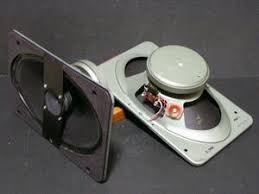


 Above, the very rare 92390PE, only made available to the mass-market since 1964 and as 'P' professional cores. High gloss finish a curious feature of elite only items, estates with a manor house, typical owners of EMI speakers. Left, Adolf Hitler's type 1932 year Siemens 13 x 8 with stray electromagnetic field copper shielding, the original EMI 13 x 8 loudspeaker.


.jpg)
.jpg)

(1).jpg)


.bmp)

 Left in the reel to reel player we had an example of the upper market in a global social system. A class war is a difficult idea for many viewers, rarely is a rainbow seen nor the social classes found to be separate. The boatyard made speaker right above belongs to social classes of the reel to reel buying level.
 Left 1960 Glyndebourne gramophone available to the purple social class as made by Thorn Electrical, who'd bought over Beam Echo. Speakers resemble EMI Broadcast 45 to this day hidden. EMI 350 high end folded horn cabinet, the model. Prototype. 92390PB has a white LSH85 electrostatic tweeter, 3.5-inch dia, later 3.125 ins, and no grey or white grille.

 Left, a 1960s Sugden console, lower-middle-class and the brand Yorkshire based, used with FANE 13 x 8 for Pure 'Class A' and Damping Factor 16 at 10 watts, later with now extinct Helme Audio kits which had a Bextrene 13 x 8 cone few have seen, there being three versions. Below a nearly extinct Benford Horn based on the 'black basket' EMI 350.


 <<1950s 9206 (British bespoke market equivalent of
DLS529 above not available to the ordinary chap). 92390V Plessey cube magnet 13 x 8 and open back 98890 tweeters have a compressed paper enclosure. Alnico woofers work with harman/kardon A 402 (on account of its being made for the JBL Century L100) so 1960s Marantz Model 8B and not 50s alnico speaker Model 8, 2 or 5.
<<1950s 9206 (British bespoke market equivalent of
DLS529 above not available to the ordinary chap). 92390V Plessey cube magnet 13 x 8 and open back 98890 tweeters have a compressed paper enclosure. Alnico woofers work with harman/kardon A 402 (on account of its being made for the JBL Century L100) so 1960s Marantz Model 8B and not 50s alnico speaker Model 8, 2 or 5. >>EMI 9206 with grille removed, note baffle thickness for low frequency accuracy. Below a 1970s SONY TA-2650 43 watt per channel system upmarket of the 22 watt per channel ζ40 TA-1630 but with a ζ25 D.F. so better suited to Hi-Fi EMI speakers. 1630, 2650 and 3650 weren't V-FET, their Bipolar sound thought just as good by dealer opinion and downmarket of expensive V-FET amplifiers of which there are many, a Solid State simulated 'tube sound', and not unique in that respect, QUAD 303 and others aimed at such but after 1980 year the industry turned away from tubes, and the ζ factor matters if using 1960s vintage Hi-Fi or Lo-Fi speakers.
.jpg)
 <<British Empire B.R.C. (British Radio Corporation) Ferguson (Thorn) SYSTEM 25 replies to SONY TA-2650 above, dated spare parts for an awesome simulated tube sound, 1960s Bipolar output devices, surprising internal build, almost Soviet, separate power and controller amplifier once aimed at a wooden radiogram crammed instead into a rack system, 3D sound from Goodmans XB25 speaker parts in a long baffle, astonished owners would never sell.
 Above EMI/HMV 556 control amplifiers for an EMI 600>> that with ζ30 dictates the maximum ζ with 1970s receivers for Hi-Fi EMI speakers, the 1984 year, Musical Fidelity A1 with ζ17 is an attractive 1980s option, ζ50 suits faster compliance speaker cones.
.png)


.jpg)


.png)
 Left, Siemens 'Dimple Top' differ from the older flat tops found in the 1957 DECCA Decola Aristocrat. The later envelope is an East German RFT with a large Getter ring.


.jpg)
.jpg)
.jpg)


 Right plywood baffle of an EMI 711 showing the higher power tweeters. Left comical GLL Oxford, probably the last speaker's failure to bring the lower man to an inclusive musical experience. Thereafter the higher society largely lost interest and quite rightly so.
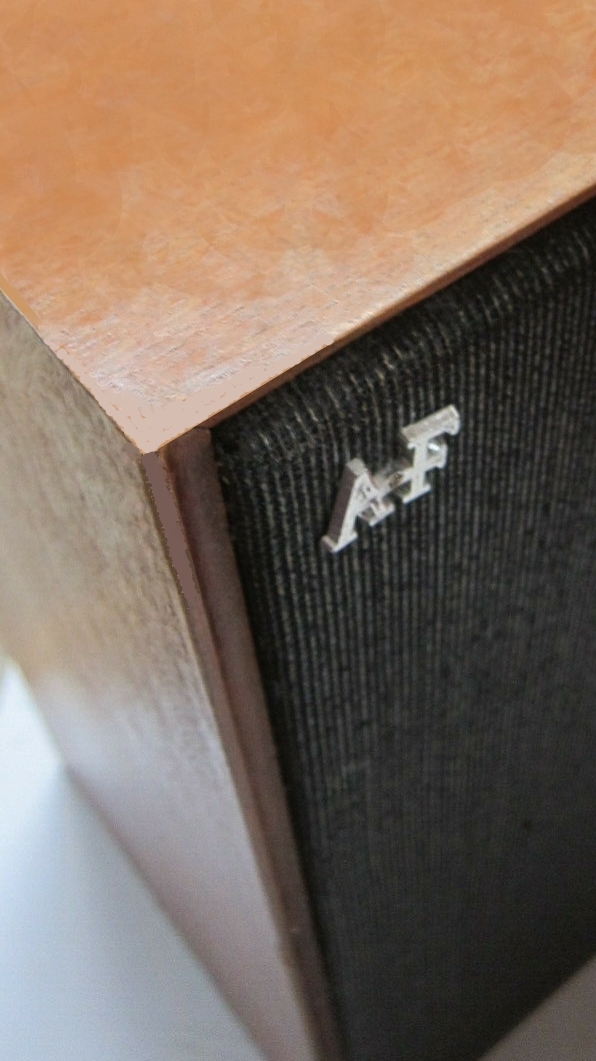 Arthur E. Falkus was a Fane founding partner, Fane 13 x 8 and tweeter AF speakers right lost in the mists of time. Keletron KN800 and KN1100 have a Falkus 13 x 8. Left 'Monolithic' QUAD II. Stereo has two small QUAD II mains transformer versions power AM, FM tuners and 22 controllers set but are often overloaded.


.jpg)
 In the 1970s EMI had Lockwood Audio sell several flat-pack cabinet kits, the L.E.4 right one of the ready-made examples. The sad thing about anything made for the lower man is the effect of price on some aspect of performance. Vintage audio mixed with modern equipment stems from an assumption that it's all alike and all sounds good to somebody.
 QUAD II is very popular today, particularly in Solid State rectifier versions. The 1982 year Concordant was by Doug Dunlop. The 1960s, elite only one left had been owned by horse racing people, its details published in the 1970 Hi-Fi News and Record Review magazine for fellow listeners of the EMI Merciless Speakers. The AcroSound made REALISTIC 210 below had a Solid State rectifier in 1962 and retains separate ECC82, unlike the Scottish Concordant modification that controversially used space compromised vacuum tube, ECC 83 to increase power to...
 ...22 watts, bettering the RCA Orthophonic. Increased power allows speakers to be further apart. QUAD II isn't much liked by the elite, using the LEAK TL12 instead but the 1950s QUAD II has a very low, 0.02% THD and was used first with Stentorian speakers when Harvard University Law graduate, 'Bud' Fried planned his I.M.F. Hi-Fi Company to import the first American, QUAD ESL57 electrostatic speakers in the 1960s. Right the stereo pair QUAD II differs from the mono sets as nearer tolerance of stereo speaker pairs sold at the time. QUAD electrostatic ESL57 gave within 40Hz-18KHz when sold in specially matched stereo amplifier/ speaker pairs, mono QUAD II reckoned too difficult to make a stereo pair from.
.jpg)


 >>14A/770C excluded from the Merciless speaker advert, part of the mid-1960s 14A series, the 950 being the 14A/600. To say nothing is known of these would be untrue, they're 105, 205, and 215, early versions have a choke on the chassis leg and they were used with Radford STA-25 valve...


 ... for a tube rectifier, later 650 for a Solid State rectifier, (red cap in choke). Lo-Fi means up to 13KHz for high-quality amplifiers of the 1940s. Left with a deep bass not mounted in gramophones, build quality tells much about capabilities, partnered with Single-Ended KT66 amplifiers below, that fetch £1000+ today at auctions as built to last a lifetime, elite vintage gets regularly refurbished. The Lo-Fi is a low Damping Factor amplifier needing the stiff pleated speaker surround. Whether 'Class A' or 'Class B', needs some trial and error.
 Right BBC style self-damping speaker enclosure by 'Heathkit of England', part of the U.S. company - uses EMI 550 below and two cube form alnico 3.5-inch tweeters (like the DLS529) but with Single-Ended amplifiers like the 'Class A' Dynatron above, supplied to Buckingham Palace. Below an actual 550 as 92390CR, one of the rarest EMI 13 x 8 and only found in 4 or 5-ohm impedance. 574G valve. Right bass-reflex slit.

 2N3614 PNP TO3 Germanium output 60V 15A 77W in the SUPERSOUND. Left, 92390CR, 5-ohm 550 13 x 8 and with no alloy center in a Lo-Fi version below still with 15-watt magnet, 10-watt coil and doped acoustic center for less pricey amplifiers and equipment. No choosing of straws for buyers of surplus 13 x 8 and vintage bargains.

 a purple social class mass market speaker, good as working well with affordable amplifiers. The next MS-400 is the 'black baffle' left with a round 12 inch EMI bass unit. An enthusiast could rebuild the x-overs to a BBC reference using the Klipsch x-over as a model. People who restore, must not paint the baffle, just leave the finish. Very difficult to improve such a surface, intended to absorb sound reflections. Painting may well look and sell better but intended sound needs it left original. As to what amplifier best suits the KEF T-15, any purple mass-market Solid State amplifier that suits a Rogers LS3/5A is easy to find.
.jpg)


 >>Celestion ring-radiator tweeters from the later 1964 year EMI 519 loudspeaker with 13 x 8 inch 92390G speaker found in the US DLS529 with similar but different acoustic loading quilting. These use an EL34 output stage different from the earlier edition with EMI cone tweeters. The x-over isn't enclosed within the black plastic box of the US export DLS529, a box that apparently prevented pressure changes from blurring the musical details, the lack of the plastic box is very strange, it might suggest export versions were higher spec but the 529 series had Plessey cube magnet cone tweeters that hadn't been of Limited Production.

.jpg)


 British export EMI Stereoscope 555 right says 'Made in England' but from a Hungarian design of the 1959 year, perhaps obscure Habsburg and Ottoman royal lineage in UK influences valued by an elite. The video set right offers +/-0.5dB, 30Hz-15KHz, 20 + 20 watts American (nearer 10 watts British power). Below chrome trim and black trim above are seen with many EMI and HMV detail differences.


 Berlant, Concord, Conrad-Johnson, Teac, Sony, Pioneer, Tandberg, Electro-Voice, Revox, DBX, Sansui, Spiral Groove, Onkyo, JVC, Panasonic, Howell FilmOSound, Univox, Webster, Hammond, Garrard, Hammarlund, Collins, Hallicrafters, Drake, Conley, Lincoln, Meisner,
  Speakers
(cores cabinets and horns) Wilson Audio, Jensen, JBL, Altec Lansing,
Western Electric, Stephens Trusonic, Tannoy, Electro-Voice, University,
RCA, General Electric, Ampex, Acoustic Research AR, Heathkit, Klipsch,
Telefunken, McIntosh, ADS, B&W, Alon, Mission, Quad, Decca, Dukane,
Dukane & EV Ionovac, Rola (Celestion), Magnavox, Eminence, C.T.S.,
Utah, Quam, Pioneer, Sansui, Bose, Allied, Knight, Infinity, Advent,
Hammond, Leslie, Vox, Fender, Allen, Fisher, Nabarro, NAB 2 (Tory MP)>>>
Speakers
(cores cabinets and horns) Wilson Audio, Jensen, JBL, Altec Lansing,
Western Electric, Stephens Trusonic, Tannoy, Electro-Voice, University,
RCA, General Electric, Ampex, Acoustic Research AR, Heathkit, Klipsch,
Telefunken, McIntosh, ADS, B&W, Alon, Mission, Quad, Decca, Dukane,
Dukane & EV Ionovac, Rola (Celestion), Magnavox, Eminence, C.T.S.,
Utah, Quam, Pioneer, Sansui, Bose, Allied, Knight, Infinity, Advent,
Hammond, Leslie, Vox, Fender, Allen, Fisher, Nabarro, NAB 2 (Tory MP)>>>


.jpg)




.jpg)
.jpg)


.png)


.jpg)


.jpg)


.jpg)


.jpg)


.jpg)

.png)

.jpg)
.jpg)




.jpg)

.png)


.jpg)

.png)


.jpg)





.jpg)

.jpg)








.jpg)